
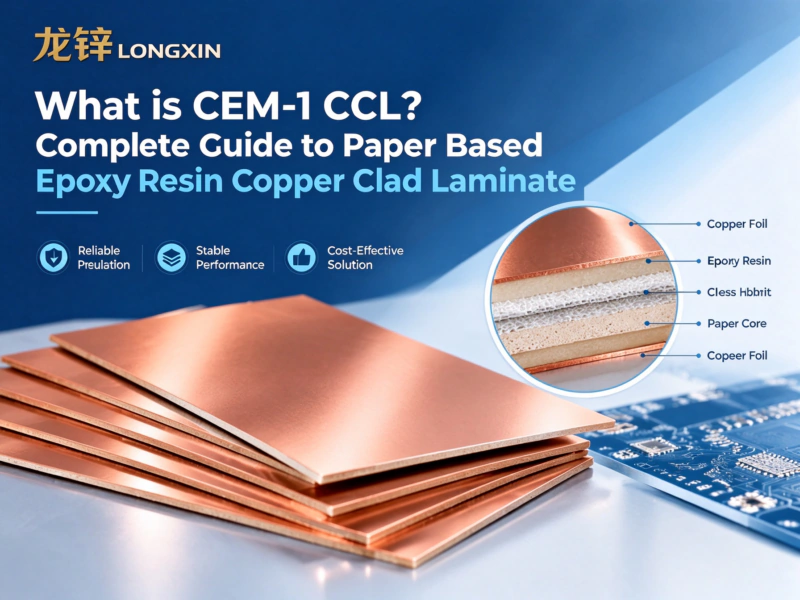
What is CEM-1 CCL? Complete Guide to Paper Based Epoxy Resin Copper Clad Laminate
CEM-1 CCL is a widely used copper clad laminate for general-purpose printed circuit board (PCB) manufacturing. It combines a paper-based core, woven glass fabric reinforcement, epoxy resin and copper foil to provide a practical balance of electrical insulation, mechanical strength, dimensional stability and cost.
For PCB manufacturers and electronic product buyers, understanding the CEM-1 CCL structure, properties, applications, specifications and material selection is important when choosing the right PCB substrate.
In this guide, we explain what CEM-1 CCL is, how it is constructed, its key properties, common applications, available specifications, and how it compares with other PCB materials.
What Is CEM-1 CCL?
CEM-1 CCL, or CEM-1 Copper Clad Laminate, is a composite epoxy material used as a base material for PCB manufacturing.
The abbreviation CEM generally refers to Composite Epoxy Material. CEM-1 uses a composite construction that combines a paper-based core with woven glass fabric reinforcement and epoxy resin. Copper foil is laminated onto the surface to create the conductive layer required for PCB fabrication.
CEM-1 is commonly selected for general-purpose and mainly single-sided PCB applications, particularly where manufacturers need a cost-effective substrate with reliable electrical and mechanical performance.
For buyers looking for ready-to-use CEM-1 material, you can view our [CEM-1 Copper Clad Laminate](/products/cem-1-copper-clad-laminate-2/) product page for specifications and quotation information.
CEM-1 CCL Structure
The structure of CEM-1 CCL is one of its most important characteristics.
A typical CEM-1 laminate consists of:
- Copper foil
- Epoxy resin
- Woven glass fabric reinforcement
- Paper-based core
- Epoxy resin bonding system
- Copper foil for double-sided constructions, where applicable
The combination of paper and glass reinforcement provides a balance between material cost, mechanical performance and processability.
Basic CEM-1 Structure
Copper Foil → Epoxy Resin + Glass Fabric → Paper Core → Epoxy Resin + Glass Fabric → Copper Foil
The exact construction can vary according to the material specification and manufacturer. Therefore, PCB manufacturers should always confirm the technical datasheet before production.
What Materials Are Used in CEM-1 CCL?
1. Copper Foil
Copper foil forms the conductive surface of the copper clad laminate.
During PCB manufacturing, the copper layer is processed through circuit imaging, etching and other fabrication steps to create the required conductive traces.
Common copper foil thicknesses may include 18 μm, 25 μm, 35 μm, 70 μm and other options, depending on the product specification.
2. Paper-Based Core
The paper-based core is an important part of the CEM-1 structure.
Compared with a fully woven-glass FR-4 construction, the paper-based composite structure can provide a more cost-conscious material solution for suitable PCB designs.
3. Woven Glass Fabric
Glass fabric reinforcement is incorporated into the CEM-1 structure to improve mechanical strength and dimensional stability.
This composite construction helps CEM-1 provide better mechanical characteristics than simpler paper-based PCB materials.
4. Epoxy Resin
Epoxy resin binds the reinforcing materials together and provides electrical insulation.
The resin system also contributes to the laminate’s mechanical strength, thermal behavior and resistance to environmental conditions.
Key Properties of CEM-1 Copper Clad Laminate
CEM-1 CCL is selected for many PCB applications because it provides a practical balance of performance and cost.
Important characteristics include:
Good Electrical Insulation
CEM-1 provides electrical insulation between conductive copper circuits and the PCB structure. This makes it suitable for many conventional electronic circuit applications.
Stable Mechanical Performance
The combination of paper core and glass fabric reinforcement provides useful mechanical strength for general-purpose PCB manufacturing.
Cost-Effective PCB Material
One of the main reasons manufacturers consider CEM-1 is its cost-performance balance.
For high-volume electronic products where extremely high thermal or mechanical performance is not required, CEM-1 can be a practical PCB substrate option.
Good Dimensional Stability
The composite reinforcement helps maintain dimensional stability during PCB processing and normal operation.
Suitable for General PCB Manufacturing
CEM-1 can be used with established PCB manufacturing processes for suitable single-sided and selected PCB designs.
CEM-1 CCL Specifications
The required CEM-1 specification depends on the PCB design and manufacturing process.
Typical purchasing specifications may include:
| Specification | Typical Options |
|---|---|
| Material | CEM-1 Copper Clad Laminate |
| Base Material | Composite Epoxy Material |
| Core | Paper + Woven Glass Fabric |
| Resin | Epoxy Resin |
| Copper Foil | Electrolytic Copper Foil |
| Copper Thickness | 18 / 25 / 35 / 70 / 105 μm |
| Board Thickness | 0.40–3.20 mm |
| Copper Sides | Single-sided / Double-sided |
| Standard Size | According to supplier specification |
| Surface | Smooth copper surface |
| Application | General-purpose PCB manufacturing |
These values should be treated as product-specific rather than universal industry values. Buyers should confirm the actual datasheet and production specification before placing an order. Longxin’s current CEM-1 product page lists customized thickness, copper foil and panel-size options. Qinmao Technology
CEM-1 CCL Applications
CEM-1 is mainly used for general-purpose PCB applications where a balance between performance and material cost is important.
Typical applications include:
Consumer Electronics
CEM-1 can be used in various consumer electronic products and control boards where the PCB design does not require the higher performance characteristics of specialized laminates.
LED Products
CEM-1 can be used for suitable LED control boards and general electronic circuits.
For applications with significant heat-generation requirements, however, an aluminum-based PCB material may be more appropriate. You can learn more about [Aluminum CCL](/products/aluminum-base-copper-clad-laminate/) and its thermal management characteristics.
Power Supply Boards
CEM-1 may be used for selected power supply and control circuits depending on the electrical and thermal requirements of the design.
Household Appliances
General-purpose control boards used in household electrical equipment can be suitable applications for CEM-1 CCL.
Industrial Electronics
CEM-1 can also be considered for selected industrial control and electronic applications where the material requirements are within its performance range.
CEM-1 CCL vs. FR-4
One of the most common questions from PCB buyers is the difference between CEM-1 and FR-4.
The main difference is their substrate construction.
CEM-1 uses a composite structure that includes a paper-based core and woven glass fabric reinforcement with epoxy resin.
FR-4 is primarily based on woven fiberglass impregnated with epoxy resin.
FR-4 is widely used for applications requiring stronger mechanical and thermal performance, while CEM-1 can be attractive for cost-sensitive general-purpose PCB applications.
| Feature | CEM-1 CCL | FR-4 CCL |
|---|---|---|
| Main reinforcement | Paper + woven glass fabric | Woven fiberglass |
| Resin | Epoxy | Epoxy |
| Cost | Generally more cost-conscious | Generally higher |
| Typical PCB use | General-purpose PCB | Broad range of PCB applications |
| Mechanical performance | Suitable for general applications | Generally higher |
| Thermal performance | Suitable for specified applications | Generally better |
| Typical selection | Cost-sensitive designs | More demanding PCB designs |
If your application requires higher mechanical or thermal performance, you can also review our [FR-4 Copper Clad Laminate](/what-is-fr4-ccl/) guide.
CEM-1 vs. CEM-3
CEM-1 and CEM-3 are both composite epoxy materials, but their reinforcement structures are different.
CEM-1 uses a paper-based core with woven glass fabric reinforcement, while CEM-3 uses a different glass-based composite construction.
In general, CEM-1 is commonly associated with cost-conscious, mainly single-sided PCB applications, while CEM-3 can be considered for applications requiring characteristics closer to fiberglass-based PCB materials.
If you are comparing the two materials for a project, see our detailed [CEM-1 vs. CEM-3 PCB Materials guide](/cem-1-cem-3-pcb-materials/).
Advantages of CEM-1 CCL
CEM-1 can offer several practical advantages for PCB manufacturers:
- Cost-effective material solution
- Good electrical insulation
- Composite mechanical reinforcement
- Suitable for many general-purpose PCB designs
- Available with different copper foil thicknesses
- Available in different board thicknesses
- Suitable for high-volume PCB production
- Can be customized according to project requirements
However, CEM-1 should not be selected simply because it is lower cost. The material must match the PCB’s electrical, thermal, mechanical and manufacturing requirements.
How to Choose the Right CEM-1 CCL
Before purchasing CEM-1 copper clad laminate, PCB manufacturers should confirm several important specifications.
1. Board Thickness
Determine the required laminate thickness according to the PCB design.
2. Copper Foil Thickness
Copper foil thickness affects the current-carrying capability and manufacturing requirements of the finished PCB.
Common requirements may include 18 μm, 25 μm, 35 μm and higher copper thicknesses.
3. Single-Sided or Double-Sided
Confirm whether the PCB requires copper foil on one side or both sides.
4. Panel Size
Provide the required panel dimensions to the supplier so material utilization and production requirements can be evaluated.
5. PCB Application
Tell the supplier what the material will be used for.
For example:
- LED lighting
- Power supply
- Household appliances
- Consumer electronics
- Control boards
- Industrial electronics
6. Required Standards
If your project requires specific certifications or technical standards, provide these requirements before quotation and production.
What Information Should You Send to a CEM-1 CCL Supplier?
To receive an accurate quotation, we recommend providing:
Material: CEM-1 CCL
Board Thickness: ___ mm
Copper Thickness: ___ μm
Copper Side: Single-sided / Double-sided
Panel Size: ___ × ___ mm
Quantity: ___ sheets
Application: ___
Required Standard: ___
Delivery Country: ___
Providing complete specifications allows the supplier to confirm material availability and prepare a more accurate quotation.
Why Choose LONGXIN for CEM-1 CCL?
Shenzhen Longxin Electronic Technology Co., Ltd. is a China-based Copper Clad Laminate manufacturer supplying CEM-1, CEM-3, FR-1, FR-4 and aluminum-based CCL products for PCB applications. Qinmao Technology
LONGXIN supports customized CCL specifications according to customer requirements, including laminate thickness, copper foil thickness and panel size. The company’s current CEM-1 product information also provides detailed technical specifications and purchasing guidance. Qinmao Technology
If you are sourcing CEM-1 copper clad laminate for PCB production, you can [view our CEM-1 CCL product](/products/cem-1-copper-clad-laminate-2/) or [browse all Copper Clad Laminate products](/product-category/copper-clad-laminate/).
For technical requirements, samples or bulk orders, contact the Longxin team with your specifications.
Frequently Asked Questions About CEM-1 CCL
What does CEM-1 stand for?
CEM-1 refers to a type of Composite Epoxy Material used in copper clad laminate for PCB manufacturing. It typically combines a paper-based core, woven glass fabric reinforcement, epoxy resin and copper foil.
Is CEM-1 suitable for single-sided PCBs?
Yes. CEM-1 is commonly used for general-purpose and mainly single-sided PCB applications. The final material selection should be based on the actual PCB design and manufacturing requirements.
What is the difference between CEM-1 and FR-4?
CEM-1 uses a composite structure containing a paper-based core and woven glass fabric reinforcement, while FR-4 primarily uses woven fiberglass with epoxy resin. FR-4 is generally selected for applications requiring higher mechanical and thermal performance.
Is CEM-1 cheaper than FR-4?
CEM-1 is generally considered a more cost-conscious PCB substrate option for suitable applications. However, actual pricing depends on thickness, copper foil, panel size, quantity and other specifications.
What copper thicknesses are available for CEM-1?
Common copper foil requirements include 18 μm, 25 μm, 35 μm and higher thicknesses. The exact available options should be confirmed with the supplier according to the project requirements.
Can CEM-1 CCL be customized?
Yes. CEM-1 CCL can be supplied according to required board thickness, copper foil thickness, panel size and other technical specifications, subject to production capability and material availability. Qinmao Technology
What information is needed for a CEM-1 CCL quotation?
Buyers should provide material type, board thickness, copper foil thickness, single-sided or double-sided construction, panel size, quantity, application and delivery destination.
Can I request a CEM-1 CCL sample?
Yes. Contact LONGXIN with your required specifications and sample requirements so the team can confirm sample availability and shipping arrangements. Qinmao Technology
Conclusion
CEM-1 CCL is a practical paper-based epoxy resin copper clad laminate for general-purpose PCB manufacturing. Its composite structure combines a paper core, woven glass fabric, epoxy resin and copper foil to provide a balance of electrical insulation, mechanical performance and cost.
For PCB manufacturers, selecting CEM-1 requires more than comparing prices. Board thickness, copper foil thickness, PCB structure, application, manufacturing process and required performance should all be considered.
If you are looking for a CEM-1 copper clad laminate manufacturer in China, LONGXIN can provide CEM-1 CCL solutions with different specifications according to your PCB requirements.
Send us your required thickness, copper foil, panel size and quantity for a quotation.


