
In today’s electronics industry, efficient heat management, reliable electrical insulation, and stable circuit performance are essential considerations in PCB material selection. As electronic devices become more compact and powerful, manufacturers increasingly look for substrate materials that can support demanding thermal and electrical requirements.
Aluminum Copper Clad Laminate (Aluminum CCL) is an important material solution for metal core printed circuit boards (MCPCBs), particularly in LED lighting, power electronics, automotive lighting, and industrial electronic applications.
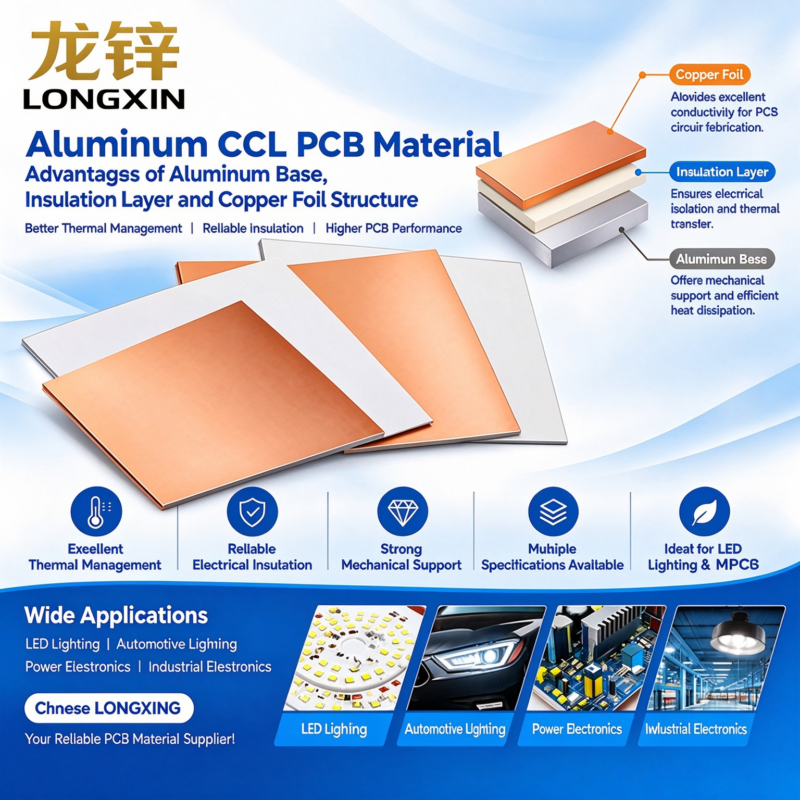
Unlike conventional PCB laminates, Aluminum CCL uses a metal-based construction consisting of three functional layers: an aluminum base, a dielectric insulation layer, and a copper foil layer. Each layer performs a different role, and their combined properties influence the performance and reliability of the finished PCB.
In this article, LONGXIN explains the structure, functions, advantages, and applications of Aluminum CCL to help PCB manufacturers and electronic material buyers understand how to select the right aluminum-based PCB substrate.
1. What Is Aluminum CCL PCB Material?
Aluminum CCL, also known as Aluminum Copper Clad Laminate or Aluminum-Based Copper Clad Laminate, is a metal-based PCB substrate material designed for circuit applications where heat transfer and electrical isolation are important.
It typically consists of three main layers:
- Copper Foil Layer: Provides the conductive material used to manufacture PCB circuit patterns.
- Dielectric Insulation Layer: Electrically separates the copper circuit from the aluminum base while providing a thermal transfer path.
- Aluminum Base Layer: Provides mechanical support and serves as a heat-transfer pathway.
These layers are bonded together to form a laminate that PCB manufacturers can process into aluminum-based printed circuit boards.
Aluminum CCL is widely considered for LED lighting boards, power supply circuits, automotive lighting modules, and other electronic assemblies where thermal management is an important design consideration.
2. Three-Layer Structure of Aluminum Copper Clad Laminate
Understanding the individual functions of the three layers is essential when selecting Aluminum CCL for PCB manufacturing.
2.1 Aluminum Base – Mechanical Support and Heat Transfer
The aluminum base is the foundation of the Aluminum CCL structure.
Its primary function is to provide mechanical support while serving as a pathway for transferring heat away from the circuit layer and toward the surrounding thermal management system.
Key Advantages of the Aluminum Base:
- Heat Transfer Capability: Aluminum provides a metal pathway for heat transfer, making it useful in PCB designs that require thermal management.
- Mechanical Strength: Supports the structure of the finished metal core PCB.
- Dimensional Stability: Helps maintain the physical structure of the substrate during normal manufacturing and application conditions.
- Lightweight Metal Construction: Offers a practical balance of mechanical support and weight.
- Application Flexibility: Can be considered for various LED lighting and power electronic designs.
For LED PCB manufacturing, the aluminum base is particularly relevant because LED components generate heat during operation. The board structure must therefore be designed to transfer heat effectively while maintaining electrical insulation.
The aluminum alloy and base thickness should be selected according to the product’s mechanical, thermal, and manufacturing requirements.
2.2 Dielectric Insulation Layer – Electrical Isolation and Thermal Management
The dielectric insulation layer is located between the copper foil and aluminum base.
This layer plays a critical role in Aluminum CCL because it must provide electrical separation while allowing heat to pass from the circuit layer toward the aluminum substrate.
Unlike an ordinary insulating layer, the dielectric material used in aluminum-based PCB laminates must balance electrical and thermal properties.
Main Functions of the Dielectric Layer:
- Electrical Isolation: Prevents direct electrical contact between the copper circuit and aluminum base.
- Thermal Transfer: Provides a pathway for heat to move toward the aluminum substrate.
- Dielectric Strength: Helps the finished PCB meet its required electrical insulation performance.
- Thermal Stability: Supports reliable operation under the intended temperature conditions.
- Structural Bonding: Maintains the laminated structure between the copper foil and aluminum base.
Why Is Dielectric Thermal Conductivity Important?
In LED lighting applications, excessive heat can negatively affect component performance and operating life.
The dielectric layer influences how efficiently heat moves from the copper circuit toward the aluminum base. Therefore, PCB manufacturers should evaluate thermal conductivity, dielectric thickness, thermal resistance, and dielectric breakdown voltage together when choosing Aluminum CCL.
Selecting a suitable dielectric material helps balance heat transfer and electrical safety requirements.
2.3 Copper Foil Layer – Electrical Conductivity and Circuit Fabrication
The copper foil is the upper conductive layer of Aluminum CCL.
During PCB manufacturing, the copper foil is processed through circuit imaging, etching, and other fabrication operations to create the required electrical pathways.
The selected copper thickness affects circuit design, current-carrying capability, and manufacturing considerations.
Advantages of the Copper Foil Layer:
- Electrical Conductivity: Provides the conductive material for PCB circuit patterns.
- Circuit Design Flexibility: Supports different circuit layouts according to the required copper thickness and trace design.
- Etching Compatibility: Can be processed using suitable PCB fabrication methods.
- Copper Adhesion: Requires appropriate bonding strength between the copper foil and dielectric layer.
- Multiple Thickness Options: Different copper foil weights can be selected for different PCB applications.
Common copper foil thickness options include 18μm, 35μm, 70μm, and other specifications depending on the laminate grade and manufacturer.
For example, 35μm copper foil is approximately equivalent to 1 oz copper and is commonly specified for PCB material applications.
When selecting copper foil, manufacturers should consider the circuit current, trace width, operating temperature, and final PCB fabrication process.
3. How Do the Three Layers Work Together?
The performance of Aluminum CCL does not depend on one layer alone. Its effectiveness comes from the combined functions of the copper foil, dielectric insulation layer, and aluminum base.
The basic heat transfer pathway is:
Electronic Components → Copper Circuit Layer → Dielectric Insulation Layer → Aluminum Base → External Heat Dissipation System
Each layer contributes to the overall PCB structure:
| Layer | Main Function | Key Consideration |
|---|---|---|
| Copper Foil | Electrical conduction and circuit fabrication | Copper thickness and adhesion |
| Dielectric Layer | Electrical insulation and heat transfer | Thermal conductivity and dielectric strength |
| Aluminum Base | Mechanical support and heat transfer | Aluminum thickness and material grade |
A properly selected Aluminum CCL structure helps PCB manufacturers balance electrical performance, thermal management, and mechanical requirements.
However, the finished PCB’s actual thermal performance also depends on circuit layout, component placement, board dimensions, mounting conditions, and the external cooling system.
4. Main Advantages of Aluminum CCL PCB Material
Aluminum-based copper clad laminate offers several advantages for electronic applications where thermal and mechanical considerations are important.
4.1 Improved Thermal Management
The metal-based construction provides a pathway for heat transfer from electronic components through the circuit and dielectric layers to the aluminum base.
This makes Aluminum CCL a suitable material to evaluate for applications involving heat-generating electronic components.
4.2 Reliable Electrical Insulation
The dielectric layer separates the conductive copper circuit from the aluminum substrate.
Its insulation performance is important for maintaining electrical isolation and meeting the PCB’s required operating conditions.
4.3 Strong Mechanical Foundation
The aluminum base provides structural support for the finished PCB and can be useful in applications requiring a rigid metal-backed board.
4.4 Flexible Material Specifications
Aluminum CCL can be supplied in different material constructions and specifications according to PCB manufacturing requirements.
Important parameters include:
- Total laminate thickness
- Aluminum base thickness
- Copper foil thickness
- Dielectric thickness
- Dielectric thermal conductivity
- Electrical insulation properties
- Panel dimensions
4.5 Suitable for LED and Power Electronics
The combination of a conductive copper surface, insulating dielectric layer, and metal base makes Aluminum CCL a practical option for many thermal-management-focused PCB applications.
5. Applications of Aluminum Copper Clad Laminate
Aluminum CCL is commonly considered for electronic products where heat management and electrical insulation are important.
LED Lighting PCB
LED lighting systems are among the major application areas for aluminum-based PCB materials.
Typical applications include:
- LED bulb circuit boards
- LED downlight PCBs
- LED spotlight modules
- LED street light circuit boards
- LED floodlight modules
- LED panel lighting boards
- High-power LED lighting assemblies
Automotive Lighting Electronics
Aluminum-based PCB materials can be evaluated for automotive lighting systems where thermal and mechanical requirements must be considered.
Examples include automotive LED headlights, daytime running lights, and other lighting control modules.
Power Supply and Power Electronics
Selected power electronic designs may use Aluminum CCL when the substrate structure and thermal requirements are compatible with the application.
Examples include power conversion modules, power control circuits, and selected electronic driver boards.
Industrial Electronics
Aluminum-based PCB materials may also be considered for industrial lighting, motor control electronics, and other equipment requiring metal-backed circuit board structures.
6. Aluminum CCL vs. Traditional FR-4 Copper Clad Laminate
Aluminum CCL and FR-4 CCL are both important PCB substrate materials, but their constructions and application considerations are different.
| Comparison | Aluminum CCL | FR-4 CCL |
|---|---|---|
| Base Material | Aluminum | Glass fiber reinforced epoxy |
| Structure | Metal-based laminate | Composite insulating laminate |
| Thermal Management | Metal base provides a heat-transfer pathway | Generally relies on the laminate and PCB thermal design |
| Mechanical Characteristics | Rigid metal-backed structure | Rigid composite structure |
| Main Applications | LED lighting and selected power electronics | General electronic PCB manufacturing |
| Material Selection | Thermal, electrical and mechanical requirements | Electrical, mechanical and thermal requirements |
Neither material is universally better. The correct choice depends on the PCB design, operating environment, heat generation, electrical requirements, manufacturing process, and overall project cost.
For additional substrate options, explore LONGXIN’s FR4 Copper Clad Laminate and other PCB material products.
7. How to Choose the Right Aluminum CCL for PCB Manufacturing?
Selecting the right Aluminum CCL requires more than simply comparing the total board thickness and copper foil weight.
PCB manufacturers should review the following parameters before purchasing:
1. Total Laminate Thickness
Confirm the required overall material thickness and distinguish it from the aluminum base thickness.
2. Copper Foil Thickness
Choose the appropriate copper foil according to the circuit’s electrical requirements and PCB design.
3. Dielectric Thermal Conductivity
Evaluate the dielectric material’s thermal conductivity based on the required heat transfer performance.
4. Dielectric Breakdown Voltage
Ensure that the material meets the electrical insulation requirements of the finished PCB.
5. Copper Peel Strength
Review copper-to-dielectric bonding performance to support reliable PCB fabrication.
6. Aluminum Base Specification
Confirm the aluminum alloy, thickness, surface condition, and mechanical requirements.
7. Panel Size and Manufacturing Compatibility
Check the sheet dimensions, flatness, and compatibility with your PCB processing equipment.
Working with an experienced Aluminum CCL supplier can help manufacturers confirm the correct material specifications before mass production.
8. Why Choose LONGXIN for Aluminum Copper Clad Laminate?
Shenzhen Longxin Electronic Technology Co., Ltd. (LONGXIN) is a professional supplier specializing in copper clad laminates and PCB material solutions for international customers.
Our product portfolio includes Aluminum CCL, FR-4, FR-1, CEM-1, and CEM-3 copper clad laminates for different PCB manufacturing requirements.
We focus on providing material options, specification confirmation, and customer-oriented supply support for PCB manufacturers, LED lighting producers, electronic material distributors, and other industrial customers.
Why Work with LONGXIN?
- Professional copper clad laminate product portfolio.
- Factory-direct material supply.
- Multiple copper foil and laminate thickness options.
- Customized material specification inquiries.
- Support for different PCB manufacturing applications.
- International customer communication and quotation support.
For more information, visit our Aluminum Base Copper Clad Laminate product page to explore the product structure, specifications, and applications.
You can also browse our Copper Clad Laminate Product Category to discover additional PCB substrate materials.
9. Frequently Asked Questions About Aluminum CCL
Q1. What are the three main layers of Aluminum CCL?
Aluminum CCL typically consists of copper foil, a dielectric insulation layer, and an aluminum base. The copper foil provides the conductive material, the dielectric layer provides electrical isolation and a thermal transfer path, and the aluminum base provides mechanical support and heat transfer.
Q2. What is the main advantage of Aluminum CCL?
Its main advantage is the metal-based construction, which provides a heat-transfer pathway while maintaining electrical isolation between the copper circuit and aluminum substrate.
Q3. Why is the dielectric layer important in Aluminum CCL?
The dielectric layer separates the copper circuit from the aluminum base electrically while allowing heat to pass through the insulating material. Both thermal conductivity and dielectric strength should be considered during material selection.
Q4. What copper foil thicknesses are available for Aluminum CCL?
Common options include 18μm, 35μm, 70μm, and other thicknesses depending on the product grade and supplier’s available specifications. Customers should confirm the exact options before ordering.
Q5. Is Aluminum CCL suitable for LED lighting PCB manufacturing?
Yes. Aluminum CCL is commonly used as a substrate material for LED lighting PCBs because its metal base provides a heat-transfer pathway. The appropriate dielectric and copper specifications must be selected according to the application.
Q6. What is the difference between Aluminum CCL and an Aluminum PCB?
Aluminum CCL is the laminated raw material used in PCB fabrication. An Aluminum PCB is the finished printed circuit board manufactured from aluminum-based laminate after circuit processing and other production operations.
Q7. Can LONGXIN supply customized Aluminum CCL?
LONGXIN supports inquiries for different laminate thicknesses, copper foil weights, aluminum base specifications, and panel dimensions. Please contact our sales team to confirm available material constructions.
10. Contact LONGXIN for Aluminum CCL Solutions
Are you looking for a reliable Aluminum Copper Clad Laminate supplier for LED lighting PCB manufacturing, power electronics, or other metal core PCB projects?
LONGXIN welcomes inquiries from PCB manufacturers, LED lighting companies, electronic material wholesalers, and international distributors.
Contact our sales team to discuss your required material specifications, panel dimensions, order quantities, and technical requirements.
LONGXIN – Your Professional Copper Clad Laminate and PCB Material Supply Partner.
Contact Person: Lisa – Sales Manager
Email: [email protected]
WhatsApp: +86 16620805869
Website: https://longxingccl.com/
Watch LONGXIN’s Video: Discover LONGXIN – Copper Clad Laminate and PCB Material Solutions
Contact LONGXIN today to discuss your Aluminum CCL requirements and request a factory-direct quotation.


