
What Is CEM-3 CCL? Complete Guide to Fiberglass Epoxy Resin Copper Clad Laminate
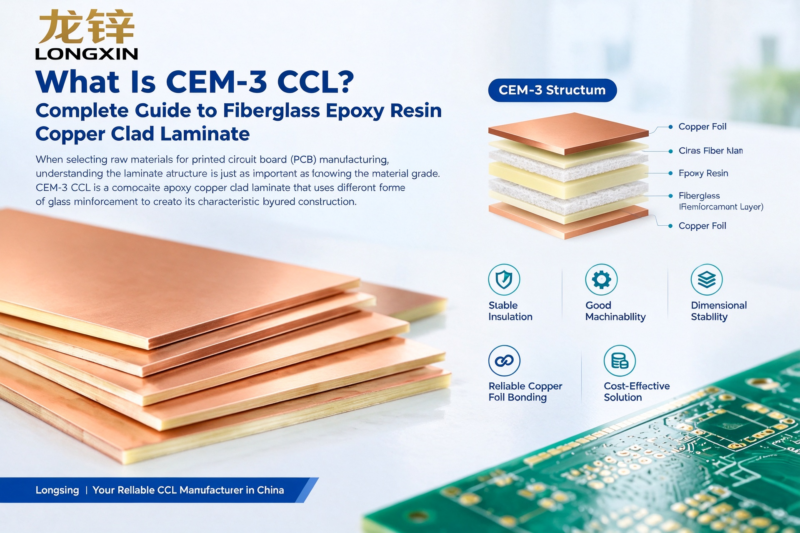
When selecting raw materials for printed circuit board (PCB) manufacturing, understanding the laminate structure is just as important as knowing the material grade. CEM-3 CCL is a composite epoxy copper clad laminate that uses different forms of glass reinforcement to create its characteristic layered construction.
For PCB engineers, purchasing teams, and electronics manufacturers, understanding how CEM-3 is constructed helps clarify which specifications need to be checked before placing an order. This guide explains the material’s composition, the role of its main layers, how it differs from other common laminates, and what buyers should confirm when sourcing CEM-3 CCL.
What Does CEM-3 CCL Mean?
CEM-3 stands for Composite Epoxy Material 3. CEM-3 CCL is a copper clad laminate made with an epoxy resin system and glass-based reinforcement.
Copper foil is bonded to the insulating laminate to create a starting material for PCB fabrication. During subsequent manufacturing, the copper layer can be processed into the circuit pattern required by the board design.
CEM-3 is often discussed as an alternative to conventional FR-4 for certain PCB designs. However, the two materials do not have identical constructions or guaranteed performance. The suitability of either material depends on its grade, the PCB design, the fabrication process, and the operating requirements of the finished product.
For more information about our material offering, visit the CEM-3 Copper Clad Laminate product page.
Understanding the Structure of CEM-3 Copper Clad Laminate
A key feature of CEM-3 is its composite reinforcement structure. A typical construction uses woven glass fabric near the outer surfaces and nonwoven glass reinforcement in the core, combined with an epoxy resin system. Copper foil is bonded to one or both sides, depending on the product construction.
1. Woven Glass Fabric Surface Layers
Woven glass fabric consists of glass yarns arranged in a woven pattern. In a typical CEM-3 laminate, the outer glass fabric layers provide reinforcement near the copper-clad surfaces.
These layers contribute to the laminate’s structural integrity and provide a reinforced surface for PCB processing. Their characteristics depend on the glass fabric, resin formulation, and manufacturing conditions.
2. Nonwoven Glass Reinforcement Core
The core typically uses nonwoven glass reinforcement rather than relying entirely on woven glass fabric. This is one of the main structural differences between CEM-3 and conventional FR-4.
The composite construction can affect how the material behaves during cutting, drilling, and other mechanical processing. Actual processing results depend on the laminate grade, thickness, tool conditions, and PCB fabrication requirements.
3. Epoxy Resin System
Epoxy resin binds the glass reinforcement together and forms the insulating matrix of the laminate. The resin formulation and curing process influence the material’s electrical, thermal, and mechanical properties.
Because CEM-3 products may use different formulations, buyers should not assume that all CEM-3 laminates have identical thermal ratings, flame-retardancy classifications, or electrical characteristics.
4. Copper Foil
Copper foil is bonded to the insulating substrate to produce the copper clad laminate. Depending on the required construction, the product may be single-sided or double-sided.
Copper foil specifications should be confirmed before ordering. Buyers should also clarify whether the stated copper value refers to the original foil or the finished copper thickness required on the fabricated PCB.
How Is CEM-3 CCL Different from FR-4 and CEM-1?
The most useful starting point when comparing these materials is their reinforcement structure. Similar product names do not mean that their construction, processing behavior, or application limits are interchangeable.
| Material | Typical Reinforcement Structure | Key Point for Buyers |
|---|---|---|
| CEM-3 | Woven glass fabric surfaces with a nonwoven glass reinforcement core | Review the grade and confirm suitability for the intended PCB design |
| FR-4 | Typically uses woven glass fabric reinforcement throughout the laminate | Check the specified FR-4 grade and required thermal, electrical, and mechanical properties |
| CEM-1 | Typically combines paper-based core material with glass fabric surface reinforcement | Confirm whether its construction meets the PCB design and fabrication requirements |
CEM-3 and FR-4 may both be considered for some PCB applications, but they should not be treated as direct substitutes without technical review. Differences in reinforcement, dimensional behavior, mechanical properties, and thermal performance may affect the manufacturing process.
CEM-1 has a different core construction from CEM-3. Therefore, a purchasing decision should be based on the actual laminate structure and the requirements of the finished circuit board, not just the material name or initial quotation.
To compare available material options, explore our CEM-1 Copper Clad Laminate product page and learn more about FR-4 CCL. You can also browse our Copper Clad Laminate product range to explore other materials for PCB manufacturing.
What Should PCB Buyers Check Before Purchasing CEM-3 CCL?
Before requesting a quotation, buyers should prepare a clear specification rather than asking for CEM-3 material by name alone.
Laminate Thickness and Tolerance
State the required nominal thickness and acceptable tolerance. Confirm whether the quoted thickness includes copper foil, as measurement conventions can differ between product specifications.
Copper Foil and Cladding Construction
Specify the required copper foil weight or thickness and whether the laminate should be single-sided or double-sided. If the material is intended for a particular PCB design, provide the relevant drawing or material specification.
Material Grade and Technical Documentation
Ask the supplier to confirm the available grade and provide the applicable technical datasheet. Review the documented properties against your design requirements instead of relying on general descriptions such as “high quality” or “high performance.”
For additional industry information, consult IPC standards and resources. Always confirm the applicable requirements and product specifications with your supplier before approving a laminate for production.
Manufacturing Process and Finished-Board Requirements
Consider the planned fabrication process, including drilling, cutting, circuit formation, and any relevant assembly conditions. If the finished board has specific thermal, electrical, or dimensional requirements, make sure these are reviewed before approving a material substitution.
Order Quantity and Panel Dimensions
Provide the required panel size, estimated quantity, and purchasing schedule. These details help the supplier assess availability and prepare a quotation based on the actual request.
Where Can CEM-3 Copper Clad Laminate Be Used?
CEM-3 may be considered for PCB designs where its documented properties and construction meet the application requirements. Potential application areas include certain consumer electronics, household appliance control boards, lighting electronics, and other general electronic products.
These are examples of application areas, not a guarantee that every CEM-3 grade is suitable for every product in these categories. Engineers should evaluate operating temperature, electrical requirements, mechanical demands, assembly conditions, and any applicable compliance standards before approving the laminate.
For designs with demanding thermal conditions, strict dimensional tolerances, or specialized electrical requirements, the material datasheet and the PCB manufacturer’s process capabilities should be reviewed carefully.
Common Mistakes When Selecting CEM-3 CCL
Choosing by material name alone: CEM-3 identifies a material family, not one universal specification. Always confirm the actual grade and technical documentation.
Assuming all copper foil specifications are equivalent: Clarify foil weight, nominal thickness, and whether the requirement concerns incoming material or finished PCB copper.
Treating CEM-3 and FR-4 as interchangeable: Similar applications do not establish technical equivalence. A substitution should be evaluated against the design and manufacturing process.
Ignoring tolerances and production conditions: Thickness, panel dimensions, and processing requirements can affect manufacturing suitability. Include these details in the quotation request.
Approving a material without reviewing documentation: Obtain and review the relevant datasheet and any required compliance documents before production approval.
How to Request a CEM-3 CCL Quotation
A clear request for quotation helps suppliers assess material requirements more efficiently. When contacting a CEM-3 CCL supplier, include the following information:
- Required material grade
- Laminate thickness and tolerance
- Copper foil weight or thickness
- Single-sided or double-sided construction
- Panel dimensions
- Estimated order quantity
- Intended application and relevant technical requirements
- Required documentation or compliance standards
If you do not have a complete specification, share your available drawing or material requirements first. The supplier can then review the information and identify which details still need confirmation.
Frequently Asked Questions About CEM-3 CCL
Is CEM-3 CCL made from fiberglass and epoxy resin?
Typical CEM-3 construction uses woven glass fabric, nonwoven glass reinforcement, and an epoxy resin system, with copper foil bonded to the insulating substrate. The exact construction should be confirmed using the relevant product documentation.
What is the main structural difference between CEM-3 and FR-4?
A typical CEM-3 laminate combines woven glass fabric surface layers with a nonwoven glass reinforcement core. Conventional FR-4 typically uses woven glass fabric reinforcement throughout. Actual performance depends on the grade and formulation.
Is CEM-3 suitable for every PCB design?
No. Suitability depends on the laminate’s documented properties, the PCB design, the fabrication process, and the operating conditions of the finished product.
What information is needed to request a CEM-3 CCL quotation?
Provide the required grade, laminate thickness, copper foil specification, cladding construction, panel dimensions, order quantity, and any applicable technical requirements. A drawing or datasheet can help clarify the request.
Can CEM-3 replace FR-4 in an existing PCB design?
Not automatically. Any substitution should be reviewed against the design requirements, fabrication process, assembly conditions, and applicable compliance requirements before approval.
Conclusion
CEM-3 CCL is a composite epoxy copper clad laminate whose structure typically combines woven glass fabric surfaces with a nonwoven glass reinforcement core. Understanding this construction helps PCB buyers ask more precise questions about material grade, thickness, copper foil, and manufacturing suitability.
Rather than selecting a laminate based on its name alone, confirm the relevant technical documentation and evaluate the material against the requirements of the finished PCB. Clear specifications help suppliers assess availability and provide more useful quotations.
Request a CEM-3 CCL Quotation from Longxin
Looking for a CEM-3 copper clad laminate supplier for your PCB manufacturing needs?
Shenzhen Longxin Electronic Technology Co., Ltd. supplies copper clad laminate materials for PCB manufacturers and electronics businesses. We welcome inquiries from PCB manufacturers, electronics companies, and material distributors.
To help us review your requirements and prepare a suitable quotation, please provide the following information:
- Required material grade
- Laminate thickness and tolerance
- Copper foil weight or thickness
- Single-sided or double-sided construction
- Panel dimensions
- Estimated order quantity
- Intended application
- Required technical documentation
If you do not have a complete specification, you can share your available drawings or material requirements for review.
Explore our CEM-3 Copper Clad Laminate product page, browse our Copper Clad Laminate product range, or visit the Longxin website to contact our team and discuss your PCB material requirements.


