
What Is the Role of Fiberglass in FR-4 CCL?
Fiberglass is an essential reinforcement material in FR-4 copper clad laminate. Although copper foil forms the conductive surface of a PCB, the glass-fiber reinforcement inside the laminate helps the substrate retain its shape and withstand the mechanical demands of circuit board fabrication and use.
For PCB manufacturers, understanding the role of fiberglass is useful when comparing laminate grades, investigating dimensional changes during processing, and selecting materials for a particular circuit design. The type of glass cloth, its construction, the resin system and the final laminate structure all contribute to the material’s overall performance.
Why Is Fiberglass Used in FR-4 CCL?
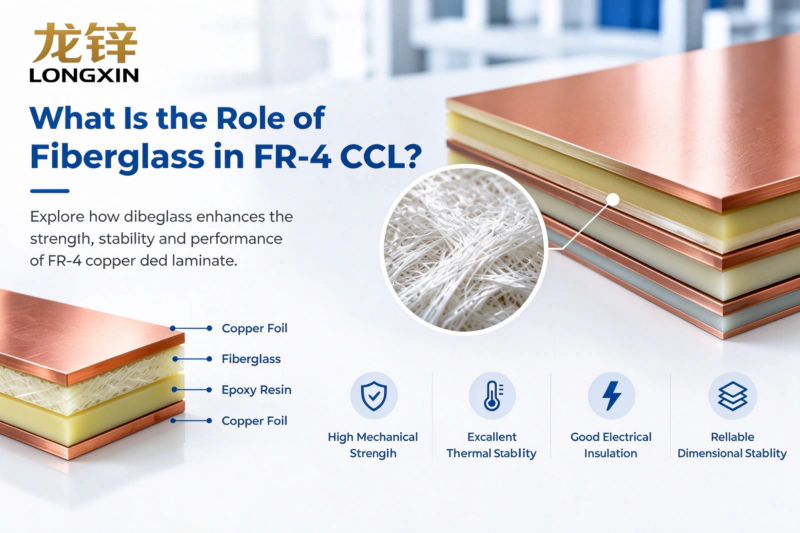
FR-4 CCL is generally made from glass-fiber fabric impregnated with epoxy resin, with copper foil bonded to one or both sides. Each constituent performs a different function.
Fiberglass acts as the reinforcing framework. Epoxy resin binds the structure together, transfers loads between the reinforcement and provides the insulating matrix. Copper foil supplies the conductive material that PCB manufacturers later process into circuit patterns.
Without suitable reinforcement, the laminate would not have the same mechanical structure and dimensional control expected from a glass-reinforced epoxy material. The interaction between glass fabric and resin is therefore central to how FR-4 behaves during manufacturing and in service.
Four Important Functions of Fiberglass in FR-4 CCL
1. Supporting Mechanical Strength
Glass fibers help the laminate resist deformation under mechanical loads. Their woven arrangement forms a reinforcing network within the epoxy matrix, helping the material maintain its structural integrity during handling, drilling and PCB fabrication.
The actual mechanical performance depends on more than the glass fibers alone. Resin formulation, glass content, fabric construction, bonding quality and lamination conditions also influence the finished material.
2. Helping Maintain Dimensional Stability
PCB production requires materials that can maintain reasonably consistent dimensions during processing. Glass-fiber reinforcement helps control dimensional changes in the laminate, although it does not eliminate expansion or contraction completely.
Glass fabric has a directional weave, commonly described in terms of warp and fill directions. Material behavior can differ between these directions. This matters when PCB manufacturers work with fine circuit patterns, layer registration or boards that undergo repeated thermal processing.
For demanding designs, buyers should review the dimensional stability data of the selected laminate grade rather than assume that all FR-4 materials behave identically.
3. Contributing to Electrical Insulation Performance
Glass fibers are non-metallic reinforcement. When combined with an appropriate epoxy resin system, they form an insulating substrate that separates conductive copper features from other layers or conductive areas.
Electrical performance is determined by the complete laminate system, not simply by the presence of fiberglass. Resin chemistry, moisture absorption, glass-resin interfaces, material thickness and the specified dielectric properties all need to be considered.
For high-speed or high-frequency circuit designs, engineers may need to evaluate dielectric constant and dissipation factor data for the exact grade under consideration.
4. Influencing Thermal and Processing Behavior
Glass reinforcement and epoxy resin respond differently to temperature. Their combined structure affects how the laminate expands, retains its shape and responds to heating during PCB fabrication and assembly.
The glass transition temperature, decomposition behavior and coefficient of thermal expansion are properties of the overall material system. They should not be inferred from the fiberglass type alone.
When a project involves lead-free soldering, repeated thermal cycles or demanding operating conditions, the laminate’s verified thermal data should be checked against the process requirements.
How Does Glass Cloth Construction Affect FR-4?
Fiberglass used in laminate is commonly supplied as woven glass cloth. The yarn arrangement, fabric style and weight influence how the cloth fits into the laminate and how the reinforcement is distributed.
Different glass cloth constructions can affect laminate thickness, resin content, mechanical behavior and the relationship between the glass and resin phases. The final outcome also depends on the resin system and the lamination process.
For purchasing teams, a glass cloth designation should not be treated as a complete performance specification. It is one part of the material description and should be considered together with the laminate grade and technical data sheet.
When comparing two FR-4 materials, check whether the products are intended for the same application and whether their documented properties meet the same requirements.
Fiberglass and Epoxy Resin: Why the Combination Matters
Fiberglass and epoxy resin work together rather than independently.
The glass fabric supplies reinforcement, while the resin surrounds the fibers, bonds the structure and transfers mechanical loads through the composite. The interface between glass and resin is also important because poor compatibility or inadequate bonding can affect the integrity of the material.
The formulation may include other ingredients to achieve the required flame-retardant, thermal or electrical characteristics. Consequently, two laminates that both use glass-fiber reinforcement may still have different performance profiles.
This is one reason why the FR-4 designation alone is not enough to determine whether a particular laminate is suitable for a demanding PCB design.
For a broader explanation of laminate construction, manufacturing stages and material selection, read our guide to FR-4 copper clad laminate.
What Should PCB Buyers Check When Selecting FR-4 CCL?
When sourcing FR-4 copper clad laminate, buyers should evaluate the complete material specification instead of focusing on fiberglass alone.
Important information includes:
- Material grade: Confirm the grade or standard required for the PCB project.
- Laminate thickness: Check the required thickness and permitted tolerance.
- Copper foil thickness: Specify the required copper weight or thickness.
- Glass and resin construction: Request the relevant material information when it affects the design or manufacturing process.
- Thermal requirements: Review the applicable Tg, decomposition and thermal expansion data where required.
- Electrical requirements: Confirm insulation and dielectric properties suitable for the intended circuit.
- Panel dimensions: Provide the required sheet or panel size.
- Order quantity: State the expected sample or production quantity.
These details help the supplier determine which available material options should be reviewed. If the design has special requirements, sharing the technical specification sheet or drawing is more useful than requesting material based on a general description alone.
You can also explore the LONGXIN FR-4 CCL product page to review product information and prepare a material inquiry.
Does More Fiberglass Always Mean Better FR-4 Performance?
Not necessarily. Increasing or changing the reinforcement content does not automatically make a laminate better for every application.
The appropriate balance depends on the fabric construction, resin system, required thickness, electrical properties, mechanical needs and manufacturing process. A material optimized for one requirement may not be the most suitable choice for another.
PCB designers and buyers should therefore compare verified data for the complete laminate grade instead of choosing a material based on one component or one isolated parameter.
FR-4 CCL and Other Copper Clad Laminate Materials
FR-4 is widely used for general-purpose rigid PCBs, but it is not the only available substrate option.
Other laminate families may use different reinforcement structures or material combinations to meet particular manufacturing, cost or performance requirements. For example, CEM-1 and CEM-3 have constructions that differ from conventional glass-fiber-reinforced FR-4, while aluminum-based CCL uses a metal base for applications where heat spreading is an important consideration.
The right material depends on the PCB design, electrical requirements, thermal conditions and fabrication capabilities.
To compare material categories, visit the LONGXIN copper clad laminate product catalog.
Frequently Asked Questions
What is the main role of fiberglass in FR-4 CCL?
Its main role is to reinforce the epoxy laminate. Glass-fiber fabric contributes to mechanical strength and dimensional stability, while also influencing the material’s overall electrical and thermal behavior.
Does fiberglass provide electrical insulation by itself?
Fiberglass is an insulating reinforcement, but the electrical performance of FR-4 depends on the complete glass-resin laminate system, including its formulation, construction and condition.
Can different glass cloth styles affect FR-4 properties?
Yes. Glass cloth construction can influence thickness, reinforcement distribution and directional behavior. The final properties also depend on the resin system and manufacturing process.
Does fiberglass determine the thermal rating of FR-4?
No. Thermal performance depends on the full material system, including the epoxy resin formulation and the laminate’s verified thermal properties. Buyers should check the data sheet for the exact grade.
What information should be supplied when requesting FR-4 CCL?
Provide the required material grade, laminate thickness, copper foil thickness, panel dimensions, order quantity and application. Include any special electrical, mechanical or thermal requirements that apply to the project.
Conclusion
Fiberglass is more than a filler in FR-4 copper clad laminate. It provides the reinforcing framework that works with epoxy resin to support mechanical integrity, dimensional control and the overall behavior of the insulating substrate.
For PCB manufacturers and material buyers, the practical approach is to evaluate the complete laminate construction and verified technical data. Choosing the right FR-4 grade requires matching the material’s documented properties to the circuit design and production process.
For further information about available material options, visit the LONGXIN FR-4 CCL product page or browse the full copper clad laminate range.
Technical reference: For additional background on glass-fiber reinforcement and PCB laminate behavior, consult the IPC technical paper on moisture control in printed circuit boards.


